


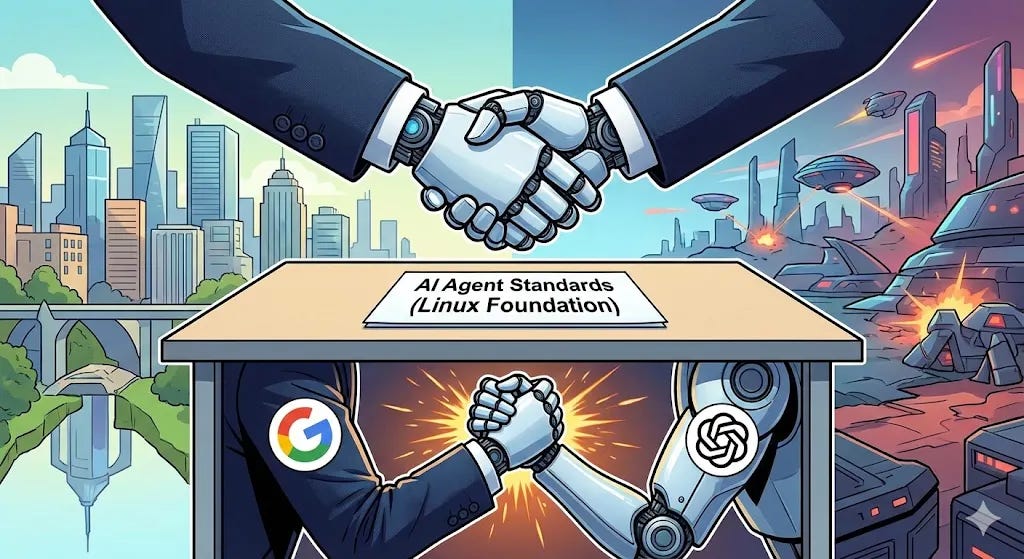
It’s a rare moment of unity as Google, OpenAI, and Anthropic join the Linux Foundation to create shared standards for AI agents. However, the cease-fire is strictly technical—both giants also released major competing agent updates on the same day to capture the market.
Tech giants launch the Agentic AI Foundation
Google officially adopts the Model Context Protocol
Google and OpenAI drop major updates simultaneously
n8n 2.0 adds Python support and UI upgrades
Case Study: How a small firm got 25% more leads with a $0 sales team
Video: Anthropic’s new argument—”Stop Building Agents”
🗞️ Weekly News
🤝 Tech giants launch Agentic AI Foundation
The Linux Foundation has partnered with OpenAI, Google, Anthropic, and Microsoft to establish a new organization focused on standardizing AI agents.
The foundation aims to create a shared framework that allows different AI systems to communicate and work together effectively.
Key goals include establishing safety protocols and preventing the ecosystem from becoming fragmented.
This initiative seeks to build trust in “agentic” workflows, where AI performs complex actions on behalf of users.
Standardizing these protocols ensures that future AI agents function reliably across different tools and platforms.
Also reported by: TechCrunch, Wired
🔌 Google adopts the Model Context Protocol
Google Cloud has officially adopted the open standard Model Context Protocol (MCP) to help developers connect AI agents to external data and tools.
Vertex AI and Gemini agents can now use the standardized protocol to interface with various enterprise data sources.
Google is releasing official, open-source MCP servers for key services like BigQuery and Google Drive to streamline integration.
The move promotes interoperability, allowing developers to use the same data connectors across different AI models and ecosystems.
This standardization significantly lowers the technical barrier for teams building agents that need secure access to proprietary data across multiple platforms.
Also reported by: TechCrunch
⚔️ Google and OpenAI release major updates on the same day
Google and OpenAI have escalated their rivalry by launching significant new AI capabilities within hours of each other.
Google introduced “Deep Research,” an autonomous agent designed to handle complex, multi-step investigations.
OpenAI immediately responded by releasing GPT-5.2, an upgraded model aimed at countering Google’s momentum following internal strategy shifts.
The simultaneous launches highlight the intense pace of development as both giants fight for dominance in agentic workflows.
This rapid competition forces teams to constantly re-evaluate which ecosystem offers the best performance for complex agent tasks.
Also reported by: TechCrunch
⚡ n8n 2.0 introduces Python support and new UI
The open-source workflow automation platform has launched its latest major version, focusing on improved developer experience and AI capabilities.
Python integration: Users can now write Python code directly inside nodes, offering a popular alternative to JavaScript for data processing.
Visual upgrades: A redesigned canvas includes sticky notes and better annotations to help teams document complex workflows.
AI agent tools: The update prioritizes features and templates specifically designed to help build and orchestrate autonomous AI agents.
Source control: Enhanced Git integration allows for better version management and collaboration across environments.
This release significantly lowers the barrier for data teams wanting to build Python-based AI agents within a low-code environment.

🔍 Other interesting reads
🔢 Number of the Week: 6%
This represents the small fraction of companies that currently trust AI agents to operate autonomously, according to a Harvard Business Review Analytic Services survey reported by Fortune.
Business leaders are hesitant to hand over full control to AI due to lingering fears about accuracy, data security risks, and the potential for “hallucinations” where the software creates false information.
The report highlights a disconnect between the hype surrounding autonomous agents and the reality of corporate governance, as most organizations still require strict human oversight before letting AI execute complex tasks.
Despite the current lack of trust, companies are not slowing down; most are proceeding with caution and continuing to experiment with the technology in hopes that reliability will improve.
💼 Use Case
A Lead Gen Bot That Paid for Itself in 21 Days
Waiver Consulting Group couldn’t scale lead generation without hiring, so they deployed an AI bot called Waiverlyn. Three weeks later, it had paid for itself entirely through booked consultations.
The numbers:
25% increase in consultations booked
9x jump in visitor engagement vs. web forms
Full ROI in 3 weeks
Zero cannibalization of existing traffic
How it works:
Waiverlyn greets every website visitor, answers questions conversationally, qualifies leads based on urgency and fit, and books consultations automatically. It creates calendar events, sends invites with video links, and updates tracking sheets—all while the team sleeps.
The system integrates with Google Calendar, email, and Sheets. No servers, no infrastructure headaches.
Why it matters:
Waiver Group isn’t a tech giant, they’re a healthcare consulting firm. The fact they deployed this in weeks and saw payback in under a month shows the barrier is lower than most SMBs think. The same pattern works for SaaS onboarding, law firm intake, medical scheduling, and any business with repetitive qualification conversations.
Read the full use case: https://insideaiagents.com/use-cases/waiver-consulting

🎥 Video of the Week
🧠 Stop Building Agents. Start Building Skills.
If you’ve been following the agent space, you know the struggle: building a custom agent for every single use case is exhausting and hard to scale.
The team at Anthropic (Barry Zhang & Mahesh Murag) just dropped a talk that flips this paradigm on its head. Their argument? Stop obsessing over the “agent” architecture and start focusing on “skills.”
In this presentation, they outline a new framework where agents are treated more like a standard runtime environment (the OS), while “skills” are just organized folders of files (Markdown, scripts, code) that any non-technical domain expert can create.
Why this matters for your startup:
Lower Barrier: You don’t need a team of engineers to build a complex agent framework.
Domain Expertise First: A Finance lead can build a “skill” just by organizing their best practices and scripts into a folder.
Portability: These skills are just files—easy to share, version control, and reuse across different workflows.
It’s a refreshing take that moves us away from “agents as black boxes” toward “agents as trainable employees” that actually get better from Day 1 to Day 30.
Watch the full talk here: